
Save Time and Money
Liquidity Planning with AI in SAP
A manual liquidity planning process can consume significant time and money while still yielding inaccurate results. Reliable planning pays off directly: Maximizing interest income, minimizing interest expenses, and reducing currency risks significantly improve financial results. Artificial Intelligence resolves this trade off by delivering maximum accuracy with minimal effort.
AI Automated Liquidity Planning: Measurable Results
+10%
Improvement in Liquidity Planning1
+90%
Forecast Quality in Liquidity Planning2
+€1 Mio.
Released Liquidity3
Before deploying Artificial Intelligence operationally, fundamental requirements must be validated: Does the existing data architecture deliver a strong signal for machine learning models, and is the business case for full automation in SAP sustainable?
Phase 1: Implementation Feasibility Analysis as a Quantitative Decision Framework
Our implementation begins with a systematic feasibility analysis. The goal is to establish a sound decision framework for management that quantifies economic and process benefits of AI deployment in advance. As SAP Treasury experts, we understand underlying SAP data structures and SAC liquidity planning requirements from numerous hands on projects. This deep process understanding enables us to audit historical data quality precisely within a short timeframe.
Structural Data Audit: Based on existing SAP cash flows, we analyze historical data quality. Actuals reporting and SAP Cash Management liquidity forecast provide the foundation. We identify precisely which liquidity planning categories, currencies, or company codes exhibit a strong signal for accurate algorithmic forecasts.
Optimization of Cash Cycles: We define concrete, measurable targets for liquidity management. Scientifically validated forecast accuracy reduces operational safety buffers on bank accounts, unlocking bound capital for value generating investments.
Business Case and ROI Calculation: We compare development and implementation costs against projected financial returns. Return on Investment measures manual effort reduction, interest income maximization, interest expense minimization, and targeted reduction of currency conversions.
Phase 2: Technological Construction of Model Architecture
Once the implementation decision is positive, the data pipeline is built using modern SAP Cloud and Data Science technologies. Our three tier architecture guarantees flexibility, audit compliance, and seamless SAP integration:
Source Independent Data Layer: Cash flows are provided fully automatically via SAP Datasphere live integration or efficiently via file export from SAP Treasury data into the Unity Catalog on SAP Databricks. The mathematical pipeline operates independently of the source, ensuring error free versioning.
Algorithm Competition (ML Layer): The pipeline evaluates 10 plus parallel statistical and machine learning methods (including Gradient Boosting, Random Forest, OLS Regression, and Theta method). Automated backtesting (champion challenger principle) determines the historically best model per time horizon and planning dimension.
Quality Validation via MASE: As a quality criterion, we utilize the MASE metric. If no ML method outperforms the seasonal baseline (MASE greater or equal to 1), the system automatically falls back to the baseline profile. A MASE value below 1 guarantees a mathematically proven improvement in SAP liquidity planning.
Risk Visibility (Uncertainty Corridors): Since cash flows exhibit volatility, forecasts provide expected values alongside a dynamic best and worst case corridor (P05 to P95 percentile). Treasury receives a reliable range indicating minimum expected liquidity at 95 percent statistical confidence.
Phase 3: Integration and Full Automation in the SAP Ecosystem
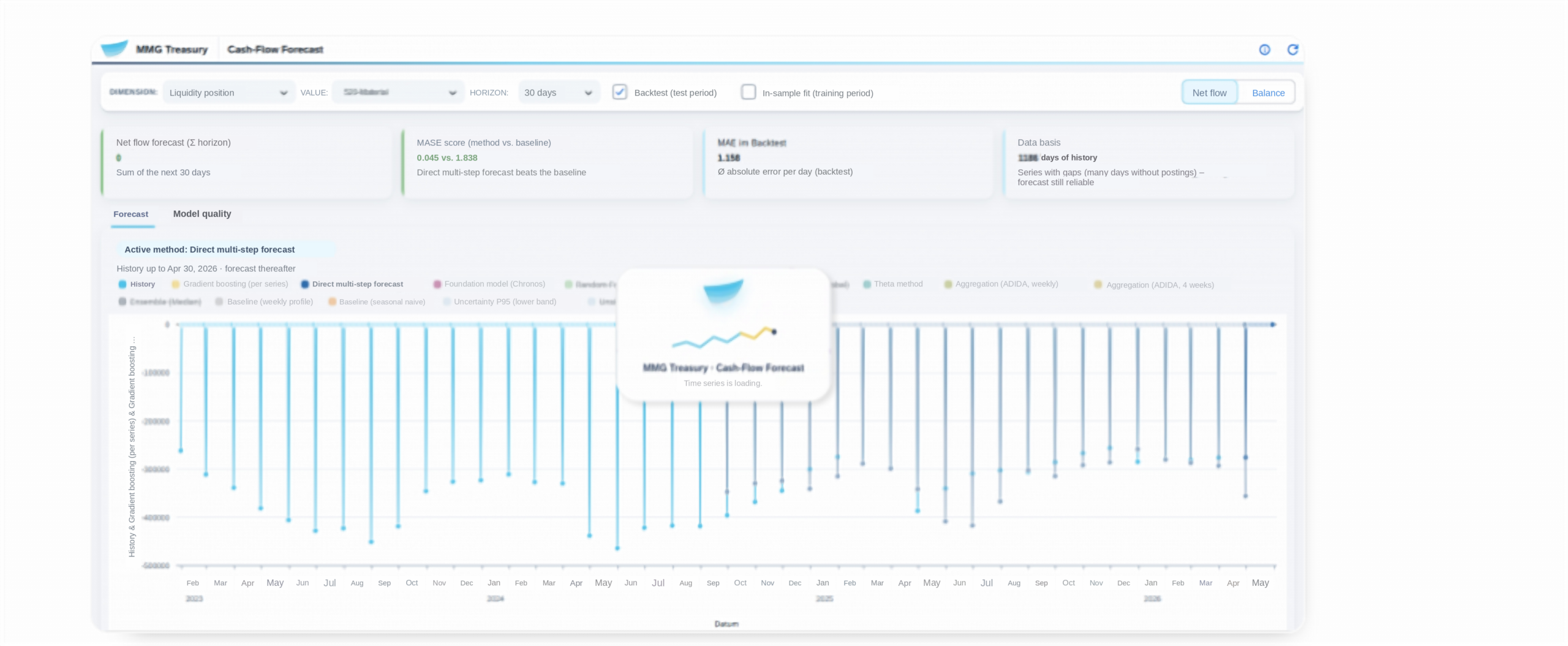
Mathematically validated results are written back directly into your existing SAP system landscape without media disruptions. For operational treasury and strategic executive management, two complementary front end options are available for parallel use:
Interactive Working Tool (SAP BTP App): Via a modern interface running on the SAP Business Technology Platform (BTP) using CAP or UI5, treasury manages AI liquidity forecasts flexibly. Dimensions, currencies, and time horizons can be selected freely. An integrated quality overview including a reliability traffic light display instantly indicates the historically optimal method and current forecast accuracy for each data series.
Hybrid Liquidity Planning (SAP Analytics Cloud): Integration into SAP Analytics Cloud (SAC) occurs live without redundant data copies via SAP Datasphere, though it remains optional. This allows flexible integration of AI generated values into your existing system environment: Liquidity planning can either be generated fully automatically from the AI forecast or selectively replace existing planning categories in a modular fashion.
The result provides a native complete solution directly within your SAP ecosystem. As treasury experts, we combine deep process knowledge from source modules and SAC planning with state of the art AI. Automated model competition delivers the proven best forecast in backtesting. Subsequent automated liquidity planning reduces staff workload measurably and significantly enhances your liquidity planning.
(1) Potential improvement through ML supported liquidity planning (Singh et al., 2024, “Liquidity forecasting at corporate and subsidiary levels using machine learning”). (2) By utilizing Advanced Analytics and ML (E&Y, 2024, “Cash forecasting: Difficult, disappointing and more urgent than ever”). (3) Based on Schierenbeck, C. (2021): Fixed Costs and Liquidity Management, 2nd Edition, Springer Gabler, pp. 185–192. Companies in the revenue range of EUR 1 billion typically maintain an operational safety buffer of approximately 3 to 5 percent of revenue (approx. EUR 30 to 50 million) due to forecast uncertainties. Utilizing data driven Predictive Analytics systems (ML) for error reduction allows this buffer to be conservatively reduced by 3 to 5 percent, representing released liquidity of at least EUR 1 to 2.5 million.
Benefit from the Following Results:
- Sound management decision framework: Validated proof of expected ROI and target cash cycle improvement based on specific liquidity planning categories and company codes.
- Higher forecast quality through model competition: Automated selection of the mathematically best method (MASE < 1) from 10 parallel statistical and ML models per company code and currency.
- Reliable risk management via bandwidths: Management based on dynamic best and worst case corridors (P05/P95) instead of error prone point estimates.
- Process automation within SAP standard: Elimination of manual Excel efforts through seamless integration into SAP BTP or SAC, flexibly via file export or live connection.
Contact us. We're here to help.
One of our experts will contact you shortly