
SAP Analytics Cloud (SAC)
Integrated Liquidity Planning with SAP Analytics Cloud
Every Beginning Is Challenging: Diverse Planning Items and Data Sources
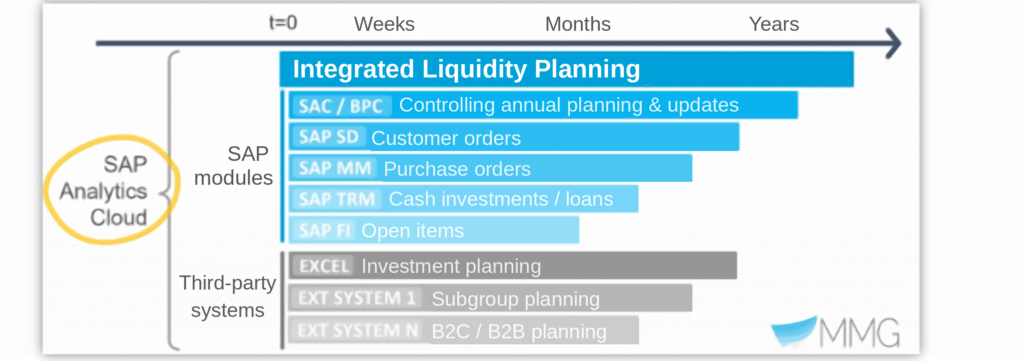
Our clients usually possess a clear vision regarding which data must flow into liquidity planning and in what format.
For example, sales planning feeds into the revenue receipts planning category. Capital expenditure disbursements originate from purchase orders in SAP MM, while cash flows from money market investments and loans stem either from SAP TRM or an external treasury management system. Generally, initial planning figures are derived from controlling planning, or if necessary, uploaded via Excel sheets.
While individual requirements can often be accommodated within existing planning tools, increased complexity frequently forces companies back to Microsoft Excel. When utilizing SAP, this reliance on Excel is no longer necessary.
Removing Complexity: Tracking the Lifecycle of a Cashflow
In the SAP Treasury domain, two core best practices have emerged, which can also be combined effectively:
-
Creating a Virtual Data Model (VDM) in SAP: CDS views build a pyramid shaped data model, granting targeted access to relevant SAP tables at the foundation and tailored exports for SAC at the top.
-
Direct data modeling in SAC: An individual data model is constructed for each topic or source, using Data Actions to transfer required values into an integrated master data model.
If data structure requirements remain uncertain, an initial sample compilation of relevant data in Excel proves helpful. This file can be converted into a test SAC data model within minutes, followed by professional data modeling with automated loading once structures are validated.
The Data Model Is Established: Build Apps and Reports
Once the initial data model is established, actual construction of the liquidity planning solution can begin.
Here as well, requirements vary significantly. For one company, deriving controlling figures using cash conversion timing is paramount. Other companies plan bottom up. Still others aim to calculate planned values automatically based on actual figures.
What unites them all: The planning solution must offer necessary flexibility. SAC handles this exceptionally well. Calculations, conversions, and aggregations can be executed directly in SAP using CDS views.
The same applies to SAC. Scripting within Data Actions delivers significant value. Allocations also process planning values effectively within SAC. Ultimately, simple calculations can be created at the model level or directly within apps and reports.
Removing Complexity: Tracking the Lifecycle of a Cashflow
Effective liquidity planning relies heavily on versioning quality. Meaningful plan vs actual and plan vs plan comparisons require versions that are quickly available and manageable. Standard SAC versioning is not fully optimal for treasury, which is why we developed a simple, robust methodology extending beyond standard SAP versioning.
Remember: Using SAP as your ERP system provides an immediate treasure trove of data. In liquidity planning, you leverage this data by reconciling plans with automatically generated short and medium term forecast values. This includes open items from accounting, sales orders from SAP SD, or purchase orders from SAP MM.
SAC also excels at scenario calculations and value driver trees, provided the data model is simple and consistent. This requirement applies equally when utilizing predictive capabilities in SAC
Benefit from Our Experience:
- Many years of experience in liquidity planning with SAC and SAP
- Avoidance of costly mistakes in building SAC liquidity planning
- Realistic project scheduling providing clarity on when existing planning systems or processes can be replaced
Contact us. We're here to help.
One of our experts will contact you shortly