
SAP Liquidity Planner / Cashflow Analyzer
Predict Liquidity Precisely
Better Liquidity Forecasting Based on Existing SAP Information
In an integrated SAP environment, almost all business departments operate within SAP. This provides a vast amount of internal data relevant for liquidity forecasting, including:
- Open receivables: Invoices issued to customers indicate expected payment dates.
- Open payables: Supplier invoices entered by accounts payable are scheduled for upcoming payment runs.
- Purchasing data: Purchase orders define prices, quantities, and agreed payment terms in advance.
- Sales data: Quotations and sales orders provide expected delivery dates and order values.
- Financial transactions: Debt management contains principal repayments and interest payments, while FX forwards specify payment dates, currencies, and cash flow amounts.
Instead of compiling these sources manually, SAP Cash Management and Cashflow Analyzer (Liquidity Planner in R/3) use standard algorithms to consolidate source data automatically into an accurate liquidity forecast
Removing Complexity: Tracking the Lifecycle of a Cashflow
Data extracted from various SAP source modules is stored centrally in the SAP Cash Management table FQM FLOW (One Exposure Hub).
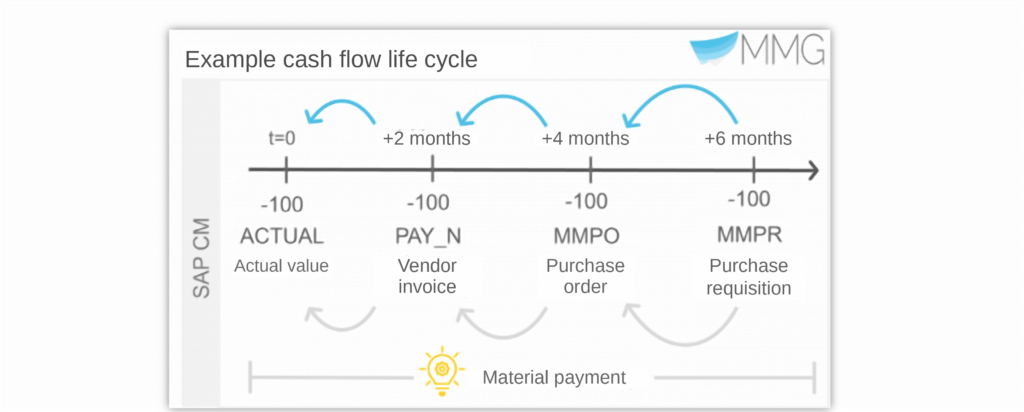
A cash flow can be tracked throughout its entire lifecycle: from an early forecast stage in a purchase requisition down to actual payment realization on the bank account.
SAP S/4HANA introduced a dedicated lifecycle concept to store and dynamically update cash flows without overlap (for example, when goods arrive or invoices are created from sales orders).
Through the certainty level rating, the origin of each cash flow can be traced at any time (such as purchase requisitions MMPR, purchase orders MMPO, TRM derivatives TRM D, or vendor invoices PAY N).
Expected payment dates are determined using delivery dates, billing dates, payment terms, or historical payment behavior (shifting expected dates if a customer consistently pays 10 days late
Differentiating Liquidity Forecasts Further: Numerous Additional Data Points Available Automatically
In R/3, SAP Liquidity Planner provides essentially the same tools, with one restriction: data generation requires executing different programs, storage occurs across several tables, and updates run on demand.
Both variants (Cashflow Analyzer in S/4HANA and Liquidity Planner in R/3) share a core mechanism: document chain analysis based on FI data reliably reads the liquidity position (such as raw materials expense in the example above) to populate the liquidity structure automatically. For SD sales orders and MM purchasing documents, additional parameters beyond account assignment (such as material) can serve as allocation criteria.
Furthermore, numerous additional data points can be extracted, including customer numbers, vendor numbers and names, profit centers, cost centers, project numbers, segment numbers, and intercompany entities.
In addition to the source modules mentioned here, SAP provides standard integration for FI-CA (for B2C business forecasts), RE-FX (real estate management), and CML (consumer mortgage loans).
Once implemented, a daily, automatically updated liquidity forecast is available, enabling early detection of liquidity bottlenecks and surpluses based on reliable data.
Benefit from the Following Results:
- Tamper proof bank communication without file interfaces
- Value date accurate bank account overview at the touch of a button and automated bank account transfers
- Integrated payment approval with extensive validation options to prevent errors and fraud
- Seamless implementation and efficient processes based on extensive experience with relevant SAP modules