
SAP Advanced Payment Management (APM)
Process Payments Quickly and Securely with SAP APM
Finally: Easily Aggregate and Process Payments from SAP and Non-SAP Systems
It is often technically challenging to transfer payments from different SAP systems within a group safely, quickly, and efficiently to the bank. It becomes even more difficult when non-SAP systems need to be integrated as well. Fortunately, SAP recognized this issue and created a solution with Advanced Payment Management (APM) that closes exactly this gap (and quite a few more, more on that later).
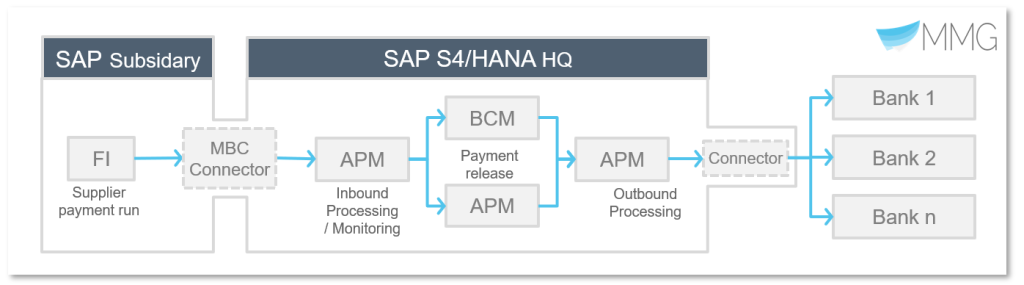
When a vendor payment run is executed in a source system (whether R/3, S/4HANA, or non-SAP) and a payment is created, the generated data can initially be transferred from the source system to the main system via SAP Multi-Bank Connectivity (MBC). In line with best practices, no editable payment files are stored physically. Instead, the transfer takes place via an RFC interface. Good to know: If desired, this connection can also be implemented without MBC using only SAP IDoc.
As soon as the payment information has been transferred to the main system (S/4HANA), APM picks up this information and carries out initial processing. This includes structured preparation according to source systems so that an overview of all payments from source systems as well as the actual S/4HANA main system is built up.
Tailor Approvals Exactly to Organizational Requirements, Enrich Payments
When it comes to executing approvals, every company and organization operates differently. From splitting between functional and liquidity approvals to multi-stage approval procedures via regional treasury hubs, everything is possible. In most cases, the relatively lean SAP Bank Communication Management (BCM) is a useful addition here to map the liquidity release.
In the event that a payment is rejected, the payment batch continues to be processed with the remaining payments. A rejection reason must mandatory be entered for the rejected payment. The initiating entity then receives an email notification stating that the payment was rejected and needs to be reprocessed. Furthermore, the corresponding FI posting generated by the payment run is corrected again.
In addition to functional approvals, payments can now also be re-routed to a specific bank, depending on which bank should execute the majority of payments from a current perspective. This happens independently of the original bank details selected in FI. Furthermore, APM can enrich payments with additional information important to the bank (for instance, the urgency level of a payment execution). Finally, both fraud and compliance checks can be connected at this stage.
No Logging into E-Banking Tools Required for Manual Payments
In addition to the significantly simplified integration of SAP and non-SAP source systems, the entry and processing of manual payments is a major advantage of APM. Previously, a manual payment could only be created in conjunction with a direct FI posting.
With APM, the FI posting takes place on the basis of the bank statement on the following day and not necessarily directly when creating the payment. Furthermore, a comprehensive entry screen is available, which can be adapted to the desired requirements.
Standardize Payment Formats Using APM
Before APM, payment formats had to be adjusted individually in each source system, which was often a recurring, labor-intensive task. With APM, maintenance is carried out once centrally in the main system. For this purpose, the payment formats of the source systems are converted using a format converter. The target format can be selected flexibly. SAP provides a comprehensive selection of payment format trees for this purpose. The actual mapping must still be set up manually, but only once centrally rather than previously across various source systems.
Contact us. We're here to help.
One of our experts will contact you shortly