
Payment Transactions with SAP
ISO 20022 in SAP Treasury: Why Companies Should Act Now
The transition to ISO 20022 is fundamentally changing electronic payment transactions, especially for companies using SAP Treasury. Despite its critical relevance, the Deloitte Global Treasury Survey (09/2024) shows that 62% of treasurers have not yet dealt intensively with the migration. It is high time to examine the impacts on processes, formats, and system landscap.
Why ISO 20022?
ISO 20022 is an international standard for electronic data interchange in payment transactions. It replaces legacy MT messages and national formats (such as DTAZV, MT101, MT940) with structured XML formats like pain.001.001.09 and camt.053.001.08. The goal is to achieve greater transparency, automated processing, and enhanced traceability of payments.
Key Opportunities for SAP Users
The migration to ISO 20022 offers far more than pure regulatory compliance. In SAP Treasury, companies can particularly benefit from the following advantages:
- Structured Remittance Information: Enables automated posting and invoice matching, minimizing manual interventions.
- UETR-Tracking:The Unique End-to-End Transaction Reference supports real-time status tracking across all involved banks.
- Batch Payments in Cross-Border Transactions: Previously limited primarily to SEPA, batching can now be efficiently used for international payments
- Structured Address Fields:Clearly defined fields in the SAP Business Partner increase data quality and significantly reduce rejected payments.
- Enhanced camt Reporting:: Detailed feedback on payments, charges, and FX conversions improves visibility in cash management.
Roadmap & Deadlines: Prepare Now
The migration follows a phased timeline, but by November 2025 at the latest, the decommissioning of many legacy formats will begin. Starting in November 2026, structured address fields become mandatory, and the parallel use of legacy messages ends entirely.
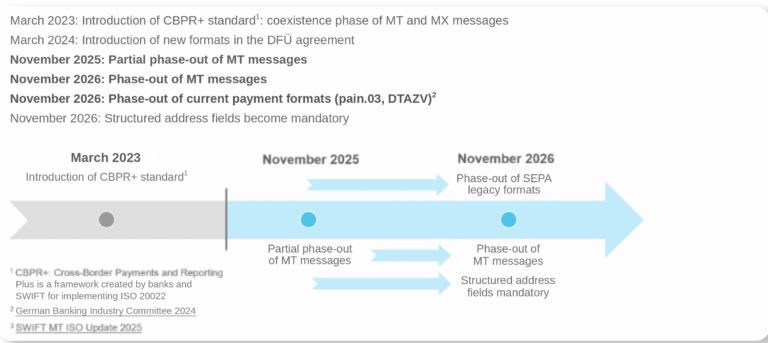
Companies that fail to comply with the new rules in time not only miss out on the aforementioned opportunities but also risk delays in payment processing as well as significantly higher bank charges.
What Exactly Is Changing?
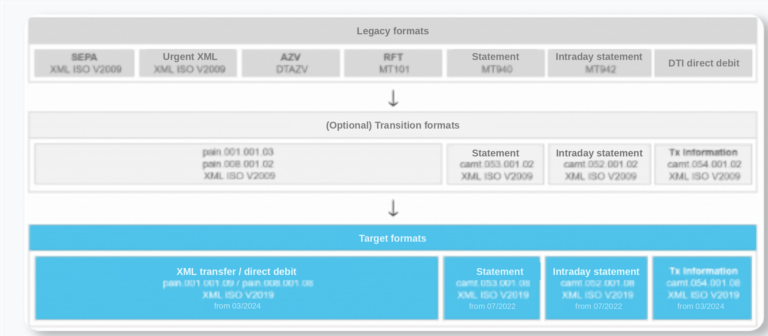
With the introduction of ISO 20022, a comprehensive change in payment transactions is lying ahead. Existing legacy formats such as MT101, MT940, or DTAZV are gradually being replaced by standardized XML formats. The new formats are based on the ISO 20022 V2019 version and enable significantly more structured, automated, and transparent payment processing.
A key difference lies not only in the file structure itself, but also in the expanded capabilities for data enrichment, for instance through structured remittance information, unique transaction references (UETR), and detailed status reports in camt format. Companies must therefore prepare for a comprehensive format migration affecting all payment types as well as bank statement formats.
The following overview shows how currently used formats can be transitioned into clearly defined target formats:
What must companies do now?
The transition to ISO 20022 affects not only the format of payment files, but also entails deep adjustments to processes, master data, system landscapes, and interaction with banks. The following overview shows which steps are typically required as part of a structured migration project:
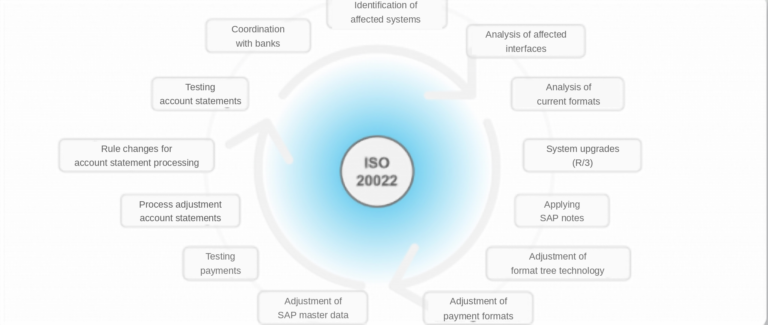
- Identification of Affected Systems
The first step is the inventory assessment: Which SAP or non-SAP systems are affected by the format change? Which modules generate or receive payment files? - Analysis of Affected Interfaces
Interfaces to banks, payment factories, or third-party software (for example TMS, payment transaction platforms) must be checked for XML compatibility and redesigned if necessary. - Analysis of Current Formats
Determine the currently used payment formats (for example DTAZV, MT101, pain.001.001.03) and compare them with target formats such as pain.001.001.09 or camt.053.001.08. - System Upgrades (SAP R/3, S/4HANA)
Not all formats are natively available in older SAP versions. Check whether system upgrades or the implementation of OSS Notes are necessary. - Implementation of SAP Notes
SAP regularly provides Notes that supplement current DMEE/DMEEX format trees and fields. Particularly relevant are for example Notes 2253571 and 2784858. - Adjustment of Format Tree Technology
Format trees in DMEE (SAP R/3) or DMEEX (S/4HANA) must be adapted to new pain/camt versions. This requires deep expertise in SAP payment transactions. - Adjustment of Payment Formats
Depending on the bank and region, different versions (for example pain.001.001.09) may be required. UETR, ChargeBearer, structured addresses, and additional fields must be implemented correctly. - Adjustment of SAP Master Data
Structured XML payments require complete and structured address data in the SAP Business Partner (BP). This mainly affects fields such as street, building number, city, and country. - Testing Payments
Test payments with banks are essential to ensure the correct processing of new XML files. Protocol reporting should also be verified during this process. - Testing Bank Statements
Feedback via camt.053 and camt.052 (instead of MT940/MT942) must also be tested. The new level of detail and structured fields allow for better automation, but require initial alignment. - Adjustment of Bank Statement Processing
Processing camt formats often requires a new or adapted interpretation of fields, for example for reference information, charges, or exchange rates. - Modification of Posting Rules for Bank Statements
Rule sets in SAP Cash Management and FI must be adjusted to correctly interpret and post structured camt data. - Alignment with Partner Banks
All adjustments should be coordinated early with house banks. Varying technical requirements (for example client identifiers, validation rules) must be incorporated into the implementation.